AI-Enabled UI/UX: Why Human Judgement Matters More Than Ever
AI can generate a website in minutes. Here's why human judgement, industry knowledge and strategic thinking matter more than ever in UI/UX design.

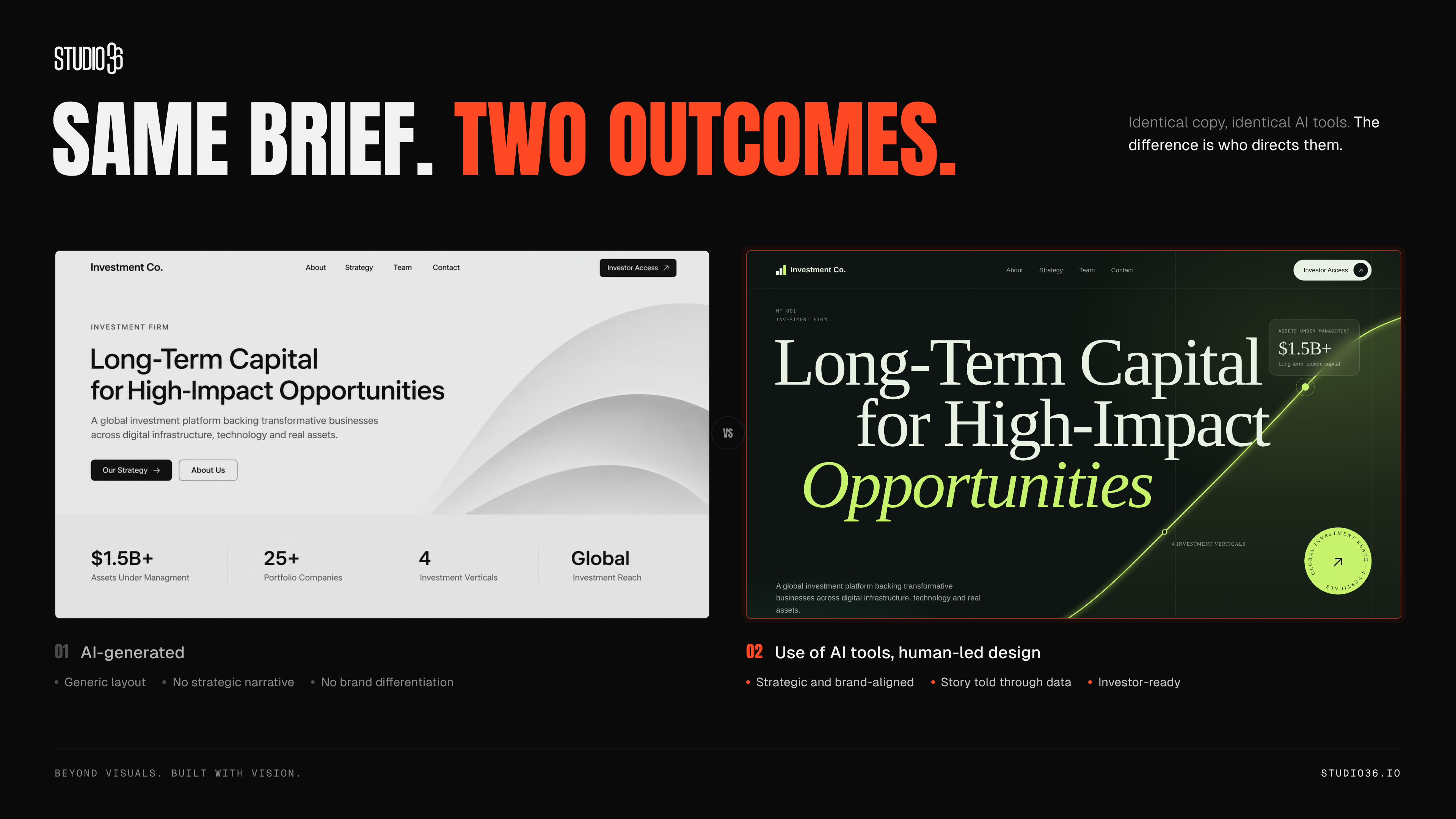
By Shideh Haghani, Lead Creative Architect at Studio36 | November 5, 2026
You Have ChatGPT and Claude. So Do We.
There was a time when designing and developing a website required weeks of planning, research, wireframing, design exploration and development before anyone could interact with a working version. Today, with the growing capabilities of generative AI, much of that initial production can happen in a fraction of the time. A prompt can generate a landing page, suggest a visual direction, write content and even produce functional code within minutes.
For those of us working in digital design, this shift has been both exciting and challenging. AI has changed not only how quickly we can produce work, but also how clients perceive the effort, expertise and value behind it. When a tool can generate something that looks remarkably close to a finished website, it naturally raises a question about the role of professional designers and creative teams.
If the tools are accessible to everyone, what exactly are clients paying for?
I think this is one of the most important questions facing our industry today, and the answer requires us to rethink how we define good design in the first place.
The Difference Between Generating a Website and Designing an Experience
One of the most interesting things about AI-generated design is how convincing the first result can be. The layouts are often clean, the typography looks considered, the visual hierarchy seems reasonable and the overall presentation follows familiar patterns that we associate with modern digital products.
But familiarity is also where the problem begins.
Spend enough time reviewing websites across technology, fintech and emerging industries, and certain visual patterns become difficult to ignore. Similar gradients, abstract illustrations, predictable page structures and messaging built around innovation, transformation and the future appear repeatedly across brands that are supposedly offering very different things.
There is a reason for this. Generative AI is particularly effective at identifying and reproducing established patterns, which makes it useful for producing a strong starting point but does not necessarily make it capable of developing a distinctive creative direction.
This does not mean AI-generated websites are inherently poor. Many are technically sound, visually appealing and perfectly adequate for their intended purpose. However, there is an important distinction between creating something that looks professional and creating something that communicates a brand's position in the market.
In my experience, particularly when working with companies in fintech, AI and emerging technology, the challenge is rarely just making a website look modern. It is understanding how a business wants to be perceived, what its audience needs to understand and how the digital experience can build credibility around a product or service that may already be complex.
A visually impressive interface can attract attention, but it takes much more considered thinking to communicate trust, clarify a complicated offering and guide someone towards a meaningful decision.
“Good design is not simply about how effectively information is presented. It is about understanding which information matters, why it matters and what the user should take away from the experience.”
AI Has Accelerated Execution, but Not Necessarily Decision-Making
Perhaps the biggest misconception surrounding AI in design is that faster production automatically leads to a faster and better project.
In reality, much of the complexity in a design process has never come from the time required to draw a component, create a layout or build a page. It comes from the decisions made before and during execution.
Should the homepage prioritise the product, the technology or the business opportunity? How much information does an investor need before developing confidence in the company? Is a particular interaction genuinely improving usability, or is it simply adding visual complexity? Does the messaging explain what the company does, or does it rely on language that sounds impressive without communicating anything meaningful?
These questions do not disappear when production becomes automated. If anything, the speed at which AI generates alternatives makes the ability to evaluate them even more important.
A designer can now explore several directions in the time it previously took to develop one. That creates an enormous opportunity for experimentation, but it also introduces a different responsibility: knowing what to keep, what to challenge and what to discard.
I have found that AI is most valuable when it allows us to spend less time on repetitive production and more time considering the decisions that influence the final experience. It can accelerate the exploration of ideas, support content structuring and simplify elements of development, but those advantages only become meaningful when there is a clear understanding of what we are trying to achieve.
Without that direction, faster execution can simply mean producing more variations of the wrong solution.
Why Industry Knowledge Still Matters
Another limitation of relying exclusively on AI-generated design is that a convincing presentation does not necessarily reflect a convincing understanding of the business behind it.
This becomes particularly apparent in industries where the products are technical, the audiences are specialised or the consequences of unclear communication are significant.
Take a fintech platform, for example. The challenge is not simply to create an attractive dashboard or explain a product using accessible language. It may involve understanding regulatory considerations, complex financial terminology, different stakeholder expectations and the level of detail required to establish trust.
Similarly, a website for an AI infrastructure company needs more than a futuristic visual identity. Its audience may be evaluating technical capabilities, deployment models, operational credibility and commercial implications. Designing for that audience requires an understanding of what influences their decisions, not just what makes the interface visually engaging.
AI can help us process information, identify patterns and translate complex material into clearer structures. However, the quality of that work still depends heavily on the context, direction and critical evaluation provided by the people using it.
From my perspective, this is where specialised design experience becomes increasingly valuable. The more accessible the tools become, the less differentiation comes from knowing how to operate them, and the more it comes from understanding the problems they are being used to solve.
The Designer's Role Is Evolving
I do not believe AI is removing the need for designers, but I do think it is changing what the role demands from us.
Historically, a significant portion of a designer's value was associated with the technical ability to execute an idea. Knowing how to build interfaces, develop detailed visual systems or translate designs into functioning digital products required specialised skills and considerable time.
Those skills still matter, but execution is becoming increasingly accessible, and I think we need to acknowledge what that means for our profession rather than resist it.
The role is moving towards a broader combination of creative direction, product thinking, technical understanding and strategic decision-making. Designers are increasingly expected to understand the business context surrounding their work, challenge assumptions, evaluate AI-generated outputs and connect design decisions to measurable outcomes.
This is particularly relevant in UI/UX, where visual quality is only one part of a successful experience. Accessibility, information architecture, usability, performance, responsiveness and consistency all influence whether a digital product actually works for the people using it.
“AI can support many of these responsibilities, but generating an output and taking responsibility for its quality are two very different things.”
I think the designers who adapt most successfully will be those who develop the confidence to work across disciplines, use AI without depending on it and approach each project with a clear understanding of both user needs and business objectives.
It is no longer enough to know how to make something look good. We need to be able to explain why a particular solution is right.
What This Means for Creative Studios
The same evolution applies to creative agencies and digital studios.
If the primary value of a studio is measured by how many pages it can produce or how quickly it can execute a predefined brief, AI will inevitably challenge that model. Clients now have access to tools that can deliver parts of the traditional production process independently, often at a significantly lower cost.
I do not necessarily see that as a negative development. In many ways, it creates an opportunity for studios to become more focused on the areas where they can make a meaningful difference.
At Studio36, working across UI/UX, development and digital experiences for technology-focused brands has made this shift particularly visible. Incorporating AI into our workflows has opened up possibilities for faster exploration, more efficient development and greater flexibility throughout the creative process.
However, it has also reinforced something I consider fundamental to our work: efficiency only creates value when it supports a thoughtful outcome.
A studio's contribution should extend beyond delivering a technically functional website. It should involve understanding the business, translating complex ideas into intuitive experiences, establishing a consistent design language and making informed decisions throughout the process.
That does not mean every project needs an extensive strategy phase or a completely bespoke approach. There are many situations where an AI-generated landing page or a simple template is precisely the right solution. The important part is recognising the difference between a project that needs a quick execution and one that requires deeper thinking.
A short-term campaign page and an investor-facing corporate website have different responsibilities, even if the same tools are capable of producing both.
The ability to make that distinction is itself a form of professional judgement.
The Future of Design Is Not Human Versus AI
I think we are moving towards a creative industry where the distinction between AI-assisted and traditionally produced work will gradually become less relevant. AI will increasingly become part of the standard workflow, much like the design and development tools that have shaped our industry over the past two decades.
What will remain important is the thinking behind the work.
The most effective digital experiences will not necessarily be the ones produced entirely by humans or the ones generated with the greatest level of automation. They will be the ones where technology is applied intentionally, creative decisions are made with context and the outcome solves a genuine problem for the people it is designed to serve.
For designers, this requires us to keep developing our judgement alongside our technical capabilities. For studios, it requires a clearer understanding of the value we provide beyond execution. And for businesses, it creates an opportunity to think more critically about what they actually need from their digital presence.
“AI has made it easier than ever to create something that looks like a finished product. The challenge now is ensuring that what we create is worth putting into the world.”
Because as the tools become more capable and accessible, the quality of the questions we ask, the decisions we make and the experiences we choose to create will matter more, not less.